


If you operate a domestic violence shelter, rape crisis center, or family justice center, then you have likely been told you need to be "HMIS-compliant."
You may also be wondering:
- Can HMIS handle all of our data?
- Should we put all survivor information into HMIS?
- Do we really need a separate survivor database?
The short answer: HMIS and survivor case management databases serve different purposes. Because of that, most victim service centers that provide housing need both.
Specifically, HUD created HMIS to be a community-wide system for HUD-funded housing programs. Meanwhile, VOCA, VAWA, and FVPSA specifically prohibit victim service providers from entering survivor PII into HMIS. Instead, VSPs receiving CoC or ESG funding must use a separate HMIS Comparable Database, while also maintaining a dedicated case management system for advocacy, legal services, counseling, and VOCA/FVPSA grant reporting.
Let's unpack that a bit:
What Is HMIS?
The U.S. Department of Housing and Urban Development requires most federally funded homeless service providers to use a Homeless Management Information System (HMIS).
The core functions of HMIS include:
- Tracking housing and homelessness services
- Standardizing data across communities
- Supporting Continuum of Care (CoC) reporting
- Generating HUD-required reports
Its purpose is system-level coordination and housing outcomes.
For organizations receiving HUD funding, HMIS participation is mandatory unless you qualify as a victim service provider with a comparable database.
What Is a Survivor Database?
On the other hand, the core function of a survivor database (sometimes called a victim services case management system) is to track:
- Crisis advocacy
- Safety planning
- Forensic accompaniment
- Legal advocacy
- Counseling services
- VOCA and state grant reporting
- Confidential recordkeeping
Additionally, these systems are designed around confidentiality, trauma-informed workflows, and funder reporting requirements outside of HUD.
HUD's Decision Tree: When to Use HMIS vs. a Comparable Database
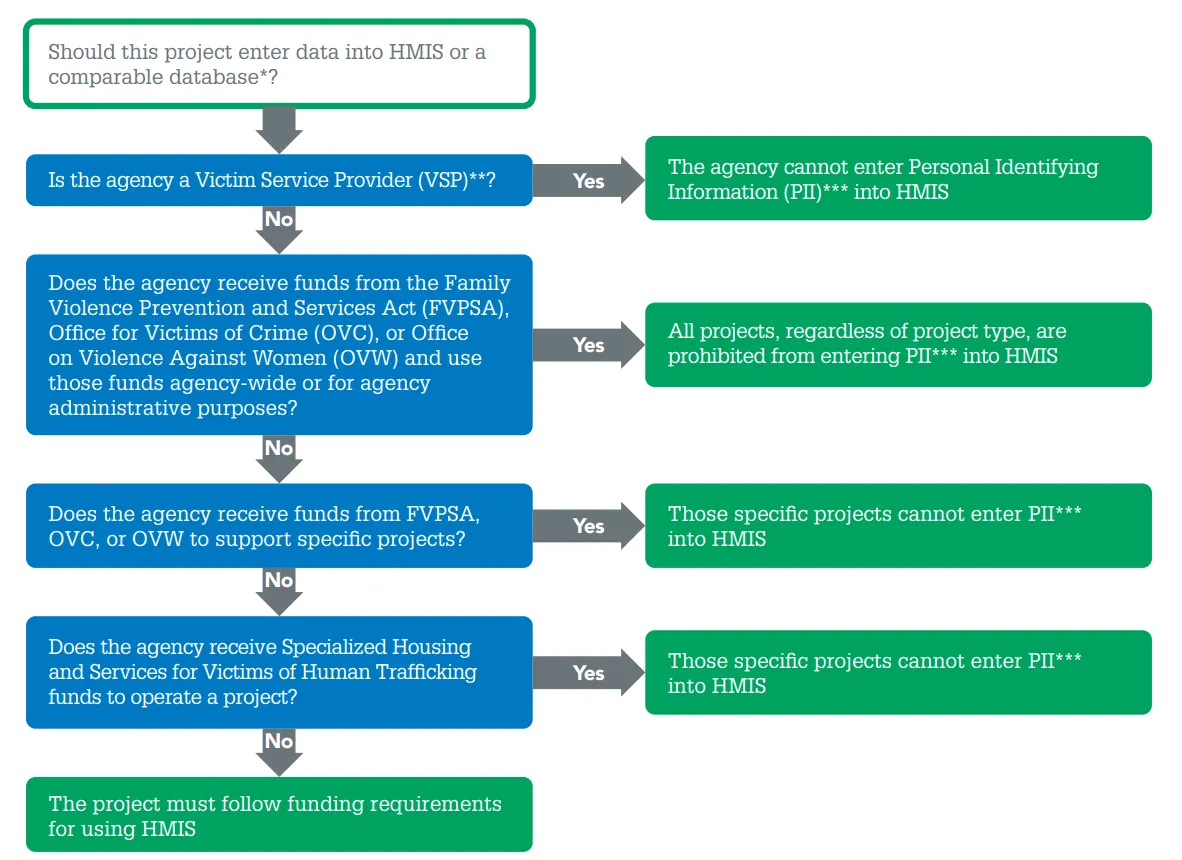
The Department of Housing and Urban Development published the decision tree below to help Victim Service Providers decide whether or not to enter Personal Identifying Information (PII) into HMIS.
The key takeaway: You should not put victim PII into HMIS without informed consent.
Why You Should Not Put Survivor Data into HMIS
HUD explicitly recognizes that victim service providers have heightened confidentiality requirements under:
Because of this, many domestic violence and sexual assault programs are either:
- Prohibited from entering identifying information into HMIS
- Or required to use a comparable database instead
Even when technically permitted, there are strong reasons not to use HMIS as your primary survivor database:
Confidentiality Risk
It is important to understand that HMIS systems are community-wide databases. That is, multiple agencies may access the system.
Despite having permissions controls, the structure of HMIS is built for coordinated housing systems -- not survivor-level confidentiality.
For guidance on survivor technology safety, organizations often rely on resources like National Network to End Domestic Violence and their Safety Net project at techsafety.org.
Limited Advocacy Workflows
HMIS is built for housing metrics:
- Entry/exit dates
- Income
- Housing status
- Bed utilization
It is not built for:
- Protective order tracking
- Detailed advocacy notes
- Accompaniment documentation
- Complex legal case workflows
Trying to force advocacy services into this system results in:
- Incomplete records
- Shadow spreadsheets
- Staff frustration
Grant Reporting Gaps
HUD reporting is not the same as VOCA reporting.
Your funders may require:
- Unduplicated survivor counts
- Demographics by victimization type
- Service hours
- Legal outcomes
- Protective order tracking
- Sexual assault forensic exam accompaniment
HUD systems do not natively handle most of these.
Why Most Victim Service Centers Need Both Systems
For many organizations:
- HMIS = Required for housing funding
- Survivor Database = Required for advocacy, legal, and grant reporting
Despite their similarities, they solve different problems.
| HMIS | Survivor Database | |
|---|---|---|
| Scope | Community-wide | Agency-controlled |
| Focus | Housing-focused | Survivor-focused |
| Reporting | HUD reporting | VOCA, FVPSA, state reporting |
| Confidentiality | Limited confidentiality controls | Built for survivor confidentiality |
Trying to consolidate everything into one system typically creates more compliance and security risk -- not less.
Understanding HMIS Comparable Databases
Victim service providers that receive HUD funds but cannot use HMIS directly must use a "comparable database."
In order to be considered a "comparable" database, a solution must:
- Collect all required HUD data elements
- Maintain equivalent security standards
- Produce HUD-compliant reports
- Protect survivor confidentiality
However, many comparable databases still struggle to meet the broader reporting needs of rape crisis centers and domestic violence programs.
Where StriveDB Fits
StriveDB was built in collaboration with the Rape Crisis Center of Central New Mexico specifically to:
- Protect survivor confidentiality
- Track detailed advocacy services
- Generate grant-ready reports
- Simplify data entry for technophobic teams
- Avoid shadow spreadsheets
Because StriveDB was built to store sensitive victim data, it is not a replacement for housing systems.
Instead, it is a purpose-built survivor case management system designed to handle:
- Advocacy
- Legal services
- Forensic accompaniment
- Complex grant reporting
For many agencies, the right structure is:
HMIS for housing + StriveDB for survivor advocacy.
The Bottom Line
HMIS was designed for housing systems while survivor databases were designed for victim services.
They are not interchangeable.
If your team is struggling with:
- Overly complex reporting
- Data privacy concerns
- Incomplete survivor records
- Duplicate data entry
- HUD vs VOCA reporting confusion
Then it may be time to clearly separate the roles of your systems.
Frequently Asked Questions
Can a victim service provider enter survivor data into HMIS?
No. VOCA, VAWA, and FVPSA explicitly prohibit victim service providers from entering survivor personally identifying information into HMIS. Instead, VSPs receiving CoC or ESG funding must use a separate HMIS Comparable Database while also maintaining a dedicated case management system for advocacy, legal services, counseling, and grant reporting.
What is an HMIS Comparable Database?
An HMIS Comparable Database is a system that collects the same data elements as HMIS using the same HUD Data Standards, but is operated separately so survivor PII is never transmitted to the community HMIS. Comparable databases still produce APR, CAPER, and LSA reports for HUD while keeping underlying identities confidential.
Do I need both HMIS and a case management database?
If your center provides housing and receives CoC or ESG funding, yes. You need an HMIS Comparable Database for HUD reporting and a full case management system for VOCA, VAWA, and FVPSA reporting, advocacy notes, counseling records, and legal services. Running one without the other will leave either your HUD reporting or your VOCA reporting broken.
Why can't one database do both HMIS and case management?
HUD's HMIS Data Standards are narrow. They capture housing outcomes, exits, and demographic rollups but not the clinical, legal, and advocacy detail that VOCA and VAWA require. A tool optimized for one creates a poor experience for the other. The practical pattern is a case management system (like StriveDB) as the system of record plus an HMIS Comparable Database that exports to HUD.